Firstly, apologies for not updating with a post about the United kits of the past. There is good reason for this, not least being a new arrival in the family. Anyway, I have recently seen several shirts being sold on ebay which sellers claim are player issued/match worn 2010-11 home shirts. Most of these are nothing of the sort.
Recently, Nike launched a new, limited edition version of the current home shirt, marketed as the Manchester United Authentic Home Shirt. It is exactly the same as the players' shirts except for one crucial difference. It has a sewn-in care label, just like the standard replicas. The real players' shirts have the care instructions printed onto the inside of the shirt. Do not be fooled.
Other than that - just like the players' shirts - it features the venting panels under the sleeves and stripes without the devil on the left sleeves.
The launch of the authentic shirt explains my previous criticism of the standard replicas. Another example of cynical marketing by Nike. The authenic shirt sells at £90 - twice the price of the standard version. I imagine it costs only a pound or two more to produce and that includes the cost of the brown cardboard box it ships in. This is a new trend I would like to see the end of. Umbro's retail shirts are exactly the same specification as their clubs' players wear, are made of far superior materials, feature fully embroidered crests and cost the same. With Umbro now being a subsiduary of Nike, this feels like replica-buying supporters of the American brand's clubs are being ripped off somewhat.

Monday, 6 December 2010

Monday, 30 August 2010
Ebay "Match Worn" Keane Shirts
Browsing ebay lately, I have noticed a lot of listings claiming to be offering genuine match worn United shirts. Some of these seem to be the real deal. While it is impossible to tell just from descriptions and photos whether they are indeed what they say they are, there are many ways to tell if the shirt is the same type that would have been issued to the players.
There are often a few differences between the match shirts worn by the players and replicas sold in shops. Often they are very subtle details which would be missed by most people, sometimes they are immediately obvious. A good example would be the 1994-96 home shirt. The replicas had printed sponsors and manufacturers logos and a machined crest whereas the players' shirts had an embossed Sharp logo and silk embroidered club crest and Umbro logo.
There are often a few differences between the match shirts worn by the players and replicas sold in shops. Often they are very subtle details which would be missed by most people, sometimes they are immediately obvious. A good example would be the 1994-96 home shirt. The replicas had printed sponsors and manufacturers logos and a machined crest whereas the players' shirts had an embossed Sharp logo and silk embroidered club crest and Umbro logo.
Recently I noticed an auction for a "match worn" Champions League issue Roy Keane shirt, which was described as follows:
MANCHESTER UNITED NO 16 ROY KEANE CHAMPIONS LEAGUE MATCH WORN SHIRT SIZE LARGE !!!!
THE SHIRT COMES WITH ALL THE DISTINGUISHING OVERSIZED NUMBERING AND LETTERING THAT DIFFERS FROM NORMAL REPLICA SHIRTS..
THE SHARP VIEWCAM SPONSORS LOGO LETTERING IS LARGER FOR TV PURPOSES AND THE CHRIS KAY FELT NUMBERING AND LETTERING ON THE REVERSE OF THE SHIRT IS LARGER THAN ON ALL REPLICA SHIRTS... THIS IS NOT TO BE MISSED OUT ON AS I THINK ALL OF YOU WILL AGREE THAT THIS WOULD BE A SUPERB ADDITION TO ANY COLLECTION !!!
ALL OUR SHIRTS ARE BRAND NEW WITH TAGS
THE SHIRT IS NOT A CHEAP ASIAN FAKE AND IS A 100% GENUINE REPLICA SHIRT
WE MUST STRESS THAT WE ONLY SELL 100% GENUINE ITEMS, WE DO NOT SELL FAKE ITEMS
ALL OUR MATCH WORN ITEMS ARE SOURCED VIA A KIT MAN IN THE PREMIER LEAGUE.
Aside from the odd contradiction at the bottom ("100% genuine replica", indeed!), this item is clearly being advertised as having been worn by Keane in a Champions League game. I noticed several details that disproved this claim and sent a message to the seller, who I had given the benefit of the doubt to. I have done similarly on other occasions and often the sellers thank me for the information and update their listings with the corrections. In this case, however, this seller did not respond to my message. It sold on the 20th of August for £112.
Just ten days later, I spotted the same item being offered by another seller and this time the description was even more forceful with the claim that it had been worn by Keane in the Champions League:
Just ten days later, I spotted the same item being offered by another seller and this time the description was even more forceful with the claim that it had been worn by Keane in the Champions League:
You are looking at a CHAMPIONS LEAGUE MATCH WORN shirt, worn by the one of United's GREATEST EVER LEGENDS....................
ROY KEANE
It was worn for one of the group games, on the way to winning the world famous TREBLE in 1999.
Roy had a TREMENDOUS season that year, and will always be remembered for his performance in the semi against Juventus, when he selflessly galvanised the side after being booked and ruled out of the final.
It's in the EXACT condition it was in when he left the field that night.
Shirt has all the differences between match issued shirts and replicas from that time (note the pictures).
THE DISTINGUISHING OVERSIZED NUMBERING AND LETTERING THAT DIFFERS FROM NORMAL REPLICA SHIRTS..
THE SHARP VIEWCAM SPONSORS LOGO LETTERING IS LARGER FOR TV PURPOSES AND THE CHRIS KAY FELT NUMBERING AND LETTERING ON THE REVERSE OF THE SHIRT IS LARGER THAN ON ALL REPLICA SHIRTS..........Complete one off. Any questions, please feel free to ask. And see my other items for more Match Shirts and sports items.
Again, there is a contradiction in the description. Firstly it states the shirt was "worn for one of the group games", then goes on to say that the shirt is in "the EXACT condition it was in when (Keane) left the field that night" - refering to the aforementioned semi final away to Juventus... where United wore their red European home shirts!
The photos used in both listings are the same, although one has been cropped - I believe to obscure a detail that was not present on the actual shirts the players wore in the Champions League that year - the black rectangular Vapatech label. That was not present on shirts worn in that competition due to strict UEFA rules. Neither was the red white and black 'flag' on the right arm. Keane always wore an XL size shirt, I am not aware of any verified match worn Keane shirts in a smaller size and the one in the auction is an L. The sponsors logos are the same size on players shirts as they are on the replicas, contrary to what is stated in the description and UEFA are stricter in regard to the size of sponsors logos than the Premier League, although there was no difference with these particular shirts.
The Champions League name and number sets are currently available to buy in the same size as was used on the players' shirts from the excellent Wiggy Sports online store, so this does not prove anything about the shirt other than that it is merely a replica with the correct retro printing applied to it.
Here is a clip of Ryan Giggs scoring in the 3-3 draw with Barcelona in the 1998-99 season while wearing the away shirt (in a home match, oddly enough):
Spot the difference:

The lesson - beware of what you see for sale on ebay. Things are not always what they claim to be.
Wednesday, 4 August 2010
Sister Blog - United Transfers
I have set up another United-based blog at manchesterunitedtransfers.blogspot.com that some readers may be interested in.
The blog is intended to become a comprehensive reference for all Manchester United transfers, with unbiassed references from national newspapers (where available) for each deal.
I have just completed the Premier League years, with the early Ferguson years to follow shortly.
The blog is intended to become a comprehensive reference for all Manchester United transfers, with unbiassed references from national newspapers (where available) for each deal.
I have just completed the Premier League years, with the early Ferguson years to follow shortly.
Thursday, 22 July 2010
Blog Updated
Having finally finished (to the best of my knowledge) all the graphics for the known United kits up to the present time, I've gone over this blog, updated all the kit images, corrected any mistakes and added any new bits of knowledge I've aquired since this project began.
Much of this has been with the help of visitors and contributors to unitedkits.com. Thanks goes out to the following:
Alessandro Bacci, John Bailey, Anthony Barras, Joel Bobrucki, Charbel Boujaoude, Mike Brannan, Alan Brennan, Keith Ellis, Alex Howells, Paul Jolleys, Brian Landamore, Leslie Millman, David Moor, Marvin Nash, Tommy Nielsen, Athanasios Papathanasiou, Simon Shakeshaft, Pete Wyatt.
There are more but it's getting late. If I've missed off your name, I apologise but feel free to shout at me in the comments box.
All the main kits worn by United and Newton Heath are available to view on my Flickr account, here. Sorry about the excessive watermarking, but a lot of stuff is getting lifted and we are not getting the credit for it unfortunately.
Wednesday, 14 July 2010
2010/11 Kits Reviewed
On July 15th, the new season's home kit was released with the away to follow a couple of months later. The home kit sees Nike opting to use a proper collar for the first time since they took over from Umbro in 2002. In fact, it looks a little like the 1980-82 adidas kit, and no doubt this was the inspiration for the designer. Lets just hope the team perform a little better in this new version than they did in the original.

As part of Nike's new 'Considered Design' range, it is made of recycled plastic bottles. Apparently this process saves 30% of the energy that would have gone into making a conventional football shirt and over the entire range has saved 254,000 kg of polyester going to waste.
Much like the current Brazil home shirt, it features a thin stripe down the sleeves and on the left arm there is a black devil. Why it could not have been a red devil is anyone's guess, frankly. The back of the shirt features an odd shadow pattern that brings to mind the emblem of the evil Decepticons from the Transformers cartoon series, and (a pet hate of mine) just below the collar the script "MUFC" is printed in the same rubbery material as the stripes. Unlike on practically every other Nike shirt this year, there is no contrast trim at the end of the sleeves, just a simple hem. Another cost cutting measure? Possibly, I feel it would have looked a fair bit better with it.
I have noticed a couple of differences between the replica versions and the players shirts. There is an extra panel of material with ventilation holes under the arms of the match shirts and the stripe on the left sleeve does not feature the devil logo. Curiously, the venting is the same as on the Brazil home jersey and is featured on the replica versions of that shirt - why have they not bothered to include it on the United shirt? Again, it can only be down to cost - very sloppy, Nike.
The away kit is sadly a victim of the current 80s fashion revival (as if it wasn't bad enough the first time around) and Nike's new-found love of jagged "lightening flash" motifs, as featured on the new Juventus and Werder Bremen kits. It's a bit of a mess, which is a shame because at least this time Nike got the colours right. A simple inverse of the home kit would have been far more pleasing - even a version of the Juventus away with red and black flashes down the centre would have been preferable.

Both shirts feature the logo of new sponsors, Aon, who reached an £80m agreement with the club in June, 2009.
Sadly, (in common with all United kits since the 2008/09 white away) both shirts also feature the cheap, machined club crests within a sewn-on patch where only the red devil is embroidered. Obviously this is a cost cutting exercise at Nike (most of their other clubs have similar crests currently), but stangely (especially considering the reduced cost of manufacture due to the recycled materials) the prices of the shirts have gone up by about £5.
Nike seem to have scant regard for UEFA rules when it comes to designing kits and once again, this will mean that they will have to use a modified version of the home shirt in European competition. The sponsor's logo will probably have to be smaller and the stripes on the sleeves most likely contravene the rule about leaving a "free zone" there to accommodate the UEFA starball and respect patches.
The home kit (with alternate white socks) was debuted by the reserves in a 4-0 win in the Jack Crompton Trophy two days before it was due to be officially revealed at Ashton Curzon's Tameside Stadium. Thanks to Paul Jolleys for the photos:


The main topic of contention about the kits though is the compatibility with the current green and gold campaign. Should supporters continue to purchase replicas if they want to be part of the protest? Is it putting more of the fans money in the Glazers pockets and prolonging their reign?
These questions are difficult to answer. In simple terms, if you are a match-going fan who is part of the green and gold movement, you should really be leaving your traditional red club colours at home anyway as it makes a better visual protest if you are seen in only the green and gold of Newton Heath rather than "diluting" it with red. It just kind of defeats the point. If you are not a match goer, it doesn't really matter what colours you wear.
At the time of the Glazer takeover, a boycott of the kits (along with other products by Nike and the other official sponsors) was urged by some supporters but was not successful. Although no real fresh attempt has been made to convince supporters to do so this year, it seems that there would likely be the same response.
Some supporters see buying the latest shirts as just another part of how they support the club, just as some see going to the match as such. There are thousands of those who do both, of course.
The facts are that under the terms of the deal United signed with Nike almost a decade ago, the sportswear firm formed a wholly-owned subsidiary to control United's global licensing and retail operations (link). The club get a guaranteed set fee in the region of £23m from Nike per year, regardless of the amount of shirts sold. In the grand scheme of Nike's business, it doesn't mean a great deal. Last year, Nike had revenues of over £12 billion. The vast majority (over 50%) of their business comes from their footwear range. They spend around 13% (roughly £1.6 billion) of their annual revenue on advertising and sponsorships, and their deal with United (even if you factor out any money Nike make from it) is worth around 1.4% of that. It's fairly obvious to say that Nike's main interest in United is in increasing their brand profile and market share. Their sponsorship of United guarantees their swoosh logo a place in the sports pages of newspapers worldwide almost every day of the year. A few hundred thousand £40 shirts not sold would not make a difference to Nike or ultimately to the Glazers either.
Doing things to make sure that the Glazer family do not continue to profit from fans is something many of us are rightly concerned about, but I really do not believe on the available evidence that boycotting shirts will have any effect at all other than to save the would-be customer £40 or so. Ultimately, do what you think is best for your club and for yourself.
Tuesday, 27 April 2010
1946-1948: A New Dawn
The Football League was finally resumed on Saturday, August 31st 1946. United's first match was against Grimsby at "home" at Maine Road - a 2-1 win with goals from Rowley and Mitten. The Reds turned out in new kits which I believe were made by local sportswear manufacturers, Umbro. The style of shirts - with stiff white collars and two-buttoned white plackets - are now more commonly associated with rugby, but they would be worn by United players for the next decade. The players wore various different styles of socks throughout the season, possibly due to clothes rationing rules which would stay in force until 1949. The club had appealed to supporters to donate clothing ration coupons during the immediate post-war era, so they had obviously struggled to outfit all of their teams with sufficient kit.
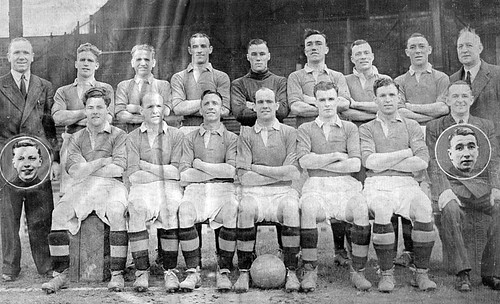
This is an edited version of an image from the extensive Leslie Millman collection, which can be found at www.flickr.com/photos/manchesterunitedman1/ and is used with full permission.
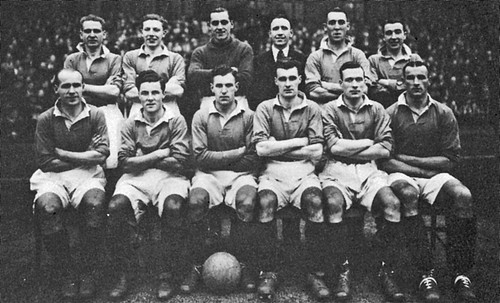
This is an edited version of an image from the extensive Leslie Millman collection, which can be found at www.flickr.com/photos/manchesterunitedman1/ and is used with full permission.
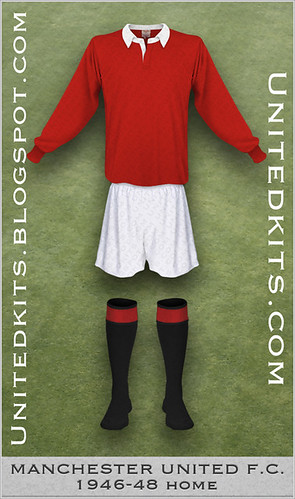
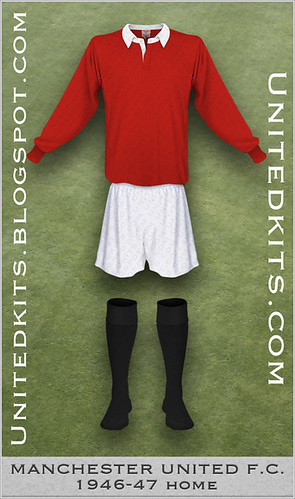
A pre-season friendly match between "red" and "blue" United sides combined with photographic evidence tells us that the club used blue change strips during this time. Besides the colour, they were identical to the red first choice shirts. As with the home kits, more than one style of socks were worn with the change strips.

This is an edited version of an image from the extensive Leslie Millman collection, which can be found at www.flickr.com/photos/manchesterunitedman1/ and is used with full permission.
The 1946/47 season saw United mount a serious challenge for the League title under Matt Busby's leadership and only in the last four matches did they fall behind eventual champions Liverpool. A 1-0 defeat at Anfield in May proving to be a pivotal moment. United's traditional poor run in the FA Cup continues however with a fourth round home loss to Nottingham Forest.
United pulled in the third highest average attendances that season with 43,945, less than 2000 behind Liverpool who topped the attendance charts with 45,732, but they brought in an average of over 4,600 more supporters than City did at their own ground. This is very odd considering the modern rival's assertion that there are no United fans in the city...
One week before the 1947/48 season commenced, United played a public practice match, this time it was billed as "reds versus whites". I have not been able to find any photographs from this match or any others from this era in which United played in white kits so it may be that it was a mistake on the programmes.
By the following season, United appear to have settled on one style of sock design and again they set out to win the league title that had eluded them for the past 36 years. Once again however, they would come second, on this occasion finishing 7 points behind Arsenal. They also finished second to Arsenal in the attendance league, bringing in a huge crowd of 54,890 - an average of just 2 supporters behind their 54,892 in an era of estimated attendances which surely could not have been accurate to such a fine degree. It is fair to say United were already one of the best supported clubs in the country at this stage and easily the best supported in Manchester, drawing in a crowd more than 12,000 supporters stronger than their sky-blue landlords. In fact, since the resumption of peacetime football, City have never recorded better attendances than United.
The 1947/48 United team in their change kits:

This is an edited version of an image from the extensive Leslie Millman collection, which can be found at www.flickr.com/photos/manchesterunitedman1/ and is used with full permission.
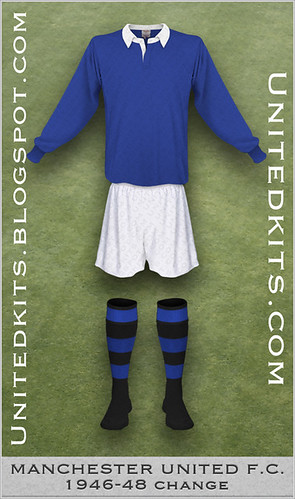
This is an edited version of an image from the extensive Leslie Millman collection, which can be found at www.flickr.com/photos/manchesterunitedman1/ and is used with full permission.
This time around, at his third attempt, Matt Busby reversed United's woeful record in the FA Cup by taking them to their first ever Wembley final against a Stanley Matthews inspired Blackpool. United wore brand new kits - royal blue shirts and socks and white shorts. The shirts differed from the regular change shirts in that the plackets were the blue instead of white. It was also adorned with an embroidered crest of the Manchester coat of arms, another first for a United kit. Photographs of these shirts clearly show that they were produced by Umbro.
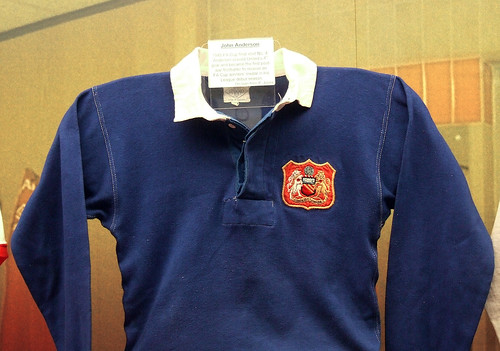
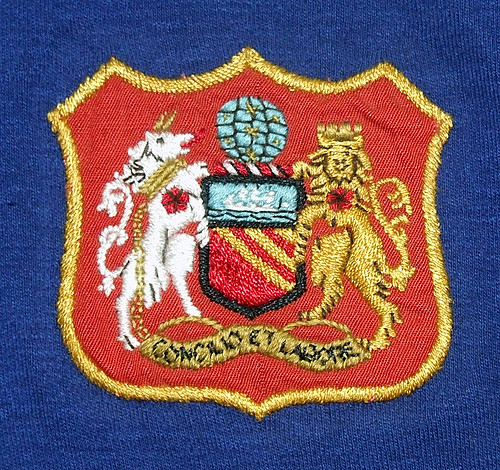

The match was a classic, with United twice falling behind in the first half only to score three in the last twenty minutes to win 4-2 and claim their first cup since 1909.
Captain Johnny Carey lifts the cup:
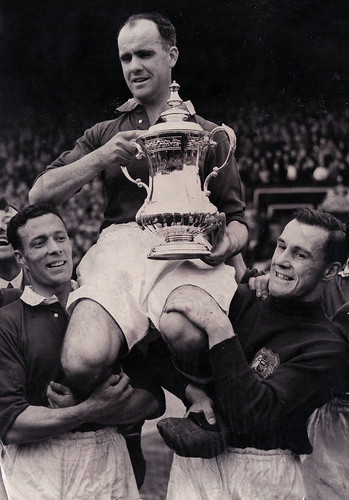
This is an edited version of an image from the extensive Leslie Millman collection, which can be found at www.flickr.com/photos/manchesterunitedman1/ and is used with full permission.
This is an edited version of an image from the extensive Leslie Millman collection, which can be found at www.flickr.com/photos/manchesterunitedman1/ and is used with full permission.
Upon their return from the capital, the players embarked on an open-topped bus ride through the streets of Manchester. Their first destination was the home of Chairman James Gibson who had missed the final due after suffering a stroke. When presented with the trophy, the ailing Gibson must surely have been assured United's era of success under Busby was well underway and that his own faith and investment in the club had at last been rewarded.
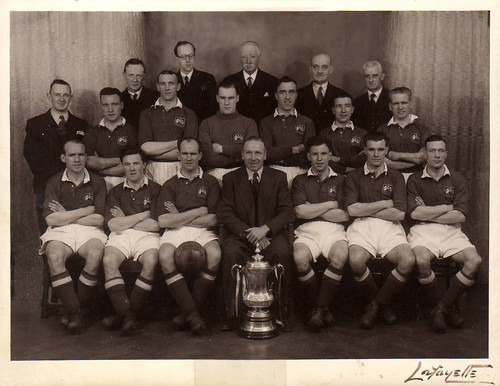
This is an edited version of an image from the extensive Leslie Millman collection, which can be found at www.flickr.com/photos/manchesterunitedman1/ and is used with full permission.
Wednesday, 20 January 2010
Updates Coming Soon...
If you are a follower of this blog, don't worry - it has not been abandoned. After a busy festive period, I have been back at work trying to get the rest of the kits on Unitedkits.com finished. We currently have everything up until the end of the adidas era accounted for (barring on or two alternate versions people have kindly made us aware of).
If you can help with any missing kits or have any suggestions, please use the comments form there.
Hopefully the remaining kits will not take too long and a new post about the immediate post-war years at Manchester United - and the switch to Umbro kits which coincided with the start of the glorious Busby era - will follow here soon.
In the meantime, it will soon be the 100th anniversary of United's move to Old Trafford, so here is a photograph to bring back memories in any centenarians reading!

Sunday, 29 November 2009
1939-1946: The Second World War & Beyond
On September 3rd, 1939, war was declared. The Football League was suspended the following day, although a system of regional leagues and cup competitions was established soon afterwards.
United took part in the Western Region War League during 1939-40, where they finished in fourth place. It was to have been the first Football League season where all teams were required to wear numbered jerseys after the FA had made them compulsory following a number of seasons of experimentation. Presumably clubs wore numbered kits in the regional leagues too, but the first match in which United's players adopted numbered shirts is currently a mystery.
Despite a number of famous names - Such as the great Stanley Matthews - appearing as guests for United during the war years, very few photographic records exist of the time. In fact, the only other period with such scant photo evidence to use for our purposes is the pre-1900s Newton Heath era.
Due to the onset of clothes rationing, we can only presume that the club continued to outfit the players in the kits worn in the years prior to the war, perhaps with numerous repairs and individual kits being supplied to replace those that were beyond such measures. It is very unlikely that a whole new set of kits would have been purchased during this time.
The few photos that we do have are of the MUJAC teams of 1943-44. Although in later years they wore slightly different jerseys than the first team, here they are wearing the same kits that the senior players took to the pitch in during the late 30s, albeit in very poor condition!:


As well as the youth teams above winning the Wythenshaw League Junior Cup and the Rusholme League Amateur Cup, during the course of the war, the first team won the Lancashire War Cup in 1940/41 and 1942/43, the second League North Championship in 1941/42.
The main event during this time, however was the bombing of Old Trafford. The ground was located on the edge of the industrialised Trafford Park where munitions were being manufactured for the British armed forces. It was an obvious target for the Luftwaffe and was bombed many times. On the night of March 11th 1941, German bombs hit the Main Stand, causing a great deal of destruction. James Gibson was devastated, but Manchester City were quick to offer him a solution. United were to share with City, playing home games at Maine Road. From this arrangement, City made a good amount of money, charging a rent of around £5,000 per season as well as a cut of the gate receipts. For United, they really had no other choice but to accept these conditions and so Maine Road became the temporary home of the Reds until the summer of 1949.
Matt Busby officially became Manager of United in October 1945. He had previously played for rivals City and Liverpool (who had also wanted him to join them in a management role after the war) and captained Scotland during war-time friendlies. It was Louis Rocca (again) who had sought out Busby and recommended him to James Gibson. The Chairman and Busby met in Trafford Park in February of 1945 while the Scot was still with the Army Physical Training Corps. After Busby convinced Gibson to relinquish total control over team affairs to him (something practically unheard of at the time), the contract was signed there and then. Shortly afterwards while in Italy with his Army team, Busby met Jimmy Murphy and offered him the job as his assistant. The seeds of success had been sewn.
The Football League was not revived immediately after the war ended, instead the main competition in the 1945/46 season was the FA Cup, which for that season made each tie two-legged. United beat Accrington Stanley in their first tie but were knocked out by Preston North End in the next round.
During the 1945/46 season, they were photographed in shirts that look slightly different than those worn previously. I cannot decide whether they were of a different style or simply a repair job with laces used to replace missing buttons. Further photographs will be needed to confirm this.


Sunday, 18 October 2009
A New Resource for United Fans
As I have been working on this blog, I have also been collaborating with Paul Nagel on a website on United kits. It is designed as a more accessible resource for United fans and people with an interest in football and kit history.
It has been a long time in the works now, but we've finally launched it at Unitedkits.com
It has been a long time in the works now, but we've finally launched it at Unitedkits.com

Credit for the text and build of the site is due to Paul, who I think has done a fantastic job.
Unitedkits.com is much easier to navigate than this blog, with links to each individual season, with each page containing a brief review of the events of the season and images of all the kits worn in that season. Within each season page is a link to photographic evidence (where it exists) and notes about how we've interpreted that evidence (in the case of black and white photographs). In future months, as we add more kits we intend to also have information on shirt numbering and replica versions etc.
Unitedkits.com is not designed to replace this blog, but to compliment it (and visa-versa) I will continue to post here as I have been doing and all the larger full-res images and photographs will continue to be linked to here. Enjoy.
Saturday, 17 October 2009
1934-1939: Fortunes Revived
After their flirtation with relegation to the Third Division in 1933/34, the following summer United strengthened with the signings of players such as inside forward George Mutch. After a difficult start to 1934/35, they soon went on to launch an unlikely promotion campaign. A run of eight successive wins put United in second place by mid November and by January they were still in the running. They even managed to get past their first opponents in the FA Cup (Bristol Rovers) but were knocked out by Nottingham Forest after a replay in the next round. After that, their league form deteriorated and United won only 6 out of their remaining 16 fixtures and could only finish in 5th place. Still, this was Scott Duncan's best finish to date and a marked improvement on the previous season.
The kits appear to have reverted to how they were at the start of the previous season - red was first choice and the hoops were retained as change strips.
The team photographed in change kits before the away game at Port Vale in September 1934:
The kits appear to have reverted to how they were at the start of the previous season - red was first choice and the hoops were retained as change strips.
The team photographed in change kits before the away game at Port Vale in September 1934:

The 1935/36 season was in many ways the mirror opposite of that which it followed. League form during the first half of the season was patchy and again United were knocked out of the cup after a fourth round replay. However, this time around the Reds were galvanised and went on an unbeaten run until the end of the season. A draw against Hull on the final day was enough to clinch the Second Division Championship and promotion back to the top flight after five years.
Crowds had also risen at Old Trafford during the season - in part due to this reversal of fortunes, but also because James Gibson had a platform built along the train track opposite the Main Stand to allow supporters easy access to the ground. Old Trafford Halt station still operates every match day.
Crowds had also risen at Old Trafford during the season - in part due to this reversal of fortunes, but also because James Gibson had a platform built along the train track opposite the Main Stand to allow supporters easy access to the ground. Old Trafford Halt station still operates every match day.
The station just after it was built:

The United team were photographed in two different variations of their kits during 1935/36. One is the same as worn in previous seasons while the other has socks with red turnovers and white hoops:


They were also photographed in change kits at West Ham in March 1936:

The return to the First Division was always going to be difficult for United, especially as they had failed to properly strengthen their team in the preseason, but it would have been reasonable to expect a little more fight from the team in 1936/37. With only three wins before Christmas it was a certainty that they would be struggling for survival come May.
The United team photographed in the spring of 1937 (the very odd looking player on the far left of the bottom row is recent signing George Gladwin, an outside half):

This is an edited version of an image from the extensive Leslie Millman collection, which can be found at www.flickr.com/photos/manchesterunitedman1/ and is used with full permission.
This is an edited version of an image from the extensive Leslie Millman collection, which can be found at www.flickr.com/photos/manchesterunitedman1/ and is used with full permission.
Frustratingly, two of those wins had been against a couple of the strongest sides in the country. A 3-2 derby win against eventual champions City in front of a record 68,796 crowd and a 2-0 victory over Arsenal were the highlights of a the season. Arsenal had revenge by knocking United out of the cup - again in the fourth round.
On the final day of the season an away loss to West Brom sealed United's fate - relegation to the second division, while Manchester City celebrated winning their first ever league title.
On the final day of the season an away loss to West Brom sealed United's fate - relegation to the second division, while Manchester City celebrated winning their first ever league title.
United's FA Cup defeat at Highbury was filmed for a newsreel and the players were wearing different change kits than in previous seasons. The new, thinner-hooped jerseys were presumably in the same colours of cherry and white while the shorts were dark - probably black:

Although I currently have no photographic or written evidence, I believe United retained these change kits (at least) up until the outbreak of WWII. They would probably also have worn the jerseys with white shorts:


Although 1936/37 was a failure, groundwork had begun that would stand United in good stead in the following years. Young players such as Johnny Carey and Charlie Mitten had been scouted by Louis Rocca and signed up in early 1937. Early into 1937/38, James Gibson himself spotted a promising talent in 17 year old striker Jack Rowley while staying at his holiday home in Bournemouth where Rowley had been scoring freely for the local team, and quickly signed him for United. This most likely caused friction between the chairman and the manager Duncan, who quit the Reds shortly afterwards. Again, Walter Crickmer was handed the managerial reigns on a temporary basis. This arrangement would last until the end of the Second World War.
Players photographed before a match in 1937/38:

United's form throughout the season was again inconsistent, but a final day home win against Bury saw them finish second - just above Sheffield United on goal average - to secure immediate promotion. The Cup campaign had been a slight improvement as United reached the fifth round only to be knocked out by Brentford. Meanwhile, United's rivals at Maine Road became the only side to win the Championship one season only to be relegated the next! For the second time in forty years, the fortunes of Manchester's two great clubs had been reversed.
Meanwhile, Gibson had been working hard behind the scenes towards his dream of building an all-Mancunian team at United and the MUJAC (Manchester United Junior Athletic Club) was founded with a home found for them at The Cliff on Lower Broughton Road in Broughton, Salford which had formerly been home to Broughton Rangers rugby league club. Young players such as John Aston and Johnny Anderson who would form the core of the post war team had already begun their journey which would lead the Club to greatness and glory in the coming years.
Meanwhile, Gibson had been working hard behind the scenes towards his dream of building an all-Mancunian team at United and the MUJAC (Manchester United Junior Athletic Club) was founded with a home found for them at The Cliff on Lower Broughton Road in Broughton, Salford which had formerly been home to Broughton Rangers rugby league club. Young players such as John Aston and Johnny Anderson who would form the core of the post war team had already begun their journey which would lead the Club to greatness and glory in the coming years.
The 1938/39 Manchester United team:

Alex Howells, a contributor to unitedkits.com had a trawl through the archives at Getty Images and has uncovered an image of United Vs Arsenal at Highbury in 1939. The United player appears to be wearing a blue jersey:

The season was successful enough for United. While the junior and reserve sides won their respective leagues, again the first team struggled at times but after a fairly unspectacular and unremarkable First Division campaign, they finished in a respectable 14th place. One of the few points of note is that in November 1938, a 20 year-old Allenby Chilton became the last player (to date) to be transferred directly from Liverpool to United.
Chilton would have to wait almost 8 years to make his official league debut for United, as once again, Britain found itself at war with Germany and their allies and the league was abandoned.
Chilton would have to wait almost 8 years to make his official league debut for United, as once again, Britain found itself at war with Germany and their allies and the league was abandoned.
Wednesday, 26 August 2009
1927-1934: The Great Depression
The 1927-28 season saw United revert to their traditional home colours of red and white. New jerseys with white trim inside button collars would be part of the home kit for the next three seasons (the change kit is currently unknown, but it may have been the previous home kit was used in case of a clash):

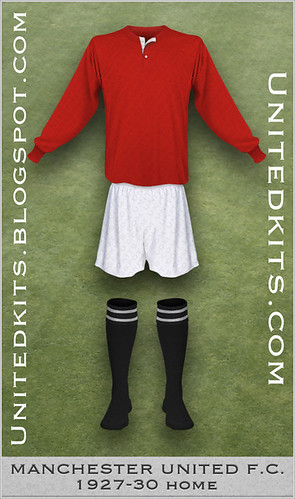
For the superstitious supporters, it was not merely a coincidence that United won their first two league games upon the return of the red jerseys - beating Bamlett's previous side Middlesbrough 3-0 at home and Wednesday 2-0 away. Sadly, after another injury put Frank Barson out of action, the run of form did not last and United went on a run of 5 games without a win, including a record 7-1 home defeat to Newcastle.
The worst was soon to come however, when in October the club's chairman and benefactor, John Henry Davies, died at the age of 63. His influence and financial backing would be sorely missed in the coming years.
The rest of the season saw United yo-yo up and down the league table. They put five goals past Villa, Derby and Leicester in the league and seven past Brentford in the cup (although they were ultimately knocked out by eventual winners Blackburn Rovers in the sixth round), but they conceded five to Everton before Derby got their revenge with a 5-0 win of their own. By the end of March, United were second from bottom, supporters were grumbling about the way the club was being run and attendances were shrinking.
On April 21st, it looked as if the return to the second division was inevitable as the Reds slumped to a 2-1 home defeat to relegation rivals Sheffield United. There were just three games to go and United needed to win all of them to stay up. Miraculously they did just that by edging out Sunderland and Arsenal with scores of 2-1 and 1-0 respectively, before hammering Liverpool 6-1 at Old Trafford on the final day to finish in a safe 18th place.
Sadly, Barson had played his last game for the club when attempting to make a comeback from injury, he suffered yet another one at Portsmouth. He was given a free transfer to Watford in the summer.
The following season saw United struggle once more. A string of injuries to key players again proved to be their undoing, leading to more criticism of the directors from the supporters who believed they should have been investing more money into the club and securing more quality signings instead of spending small amounts on endless cheap one-game-wonders. This would only intensify in the next couple of years. Following a sequence of sixteen league games without a win, the club's response was to bring in another couple of low budget players. Luckily, one of these was to prove an unlikely hit.
Tommy Reid had been signed from Liverpool, where he usually featured in the reserves. Upon being thrown into the thick of first-team action at United, however, the Scot striker managed an impressive 14 goals in 17 appearances - alongside strike partner James Hanson (who chipped in with 20 goals himself in 1928/29), he made a big contribution to United's turnaround that season. Come May, United had secured 12th place. In time-honoured style, they were knocked out of the cup in their second tie, however.
1929/30 proved to be another unspectacular struggle against threat of relegation. Eight losses in the first eleven games set the tone and in November, United received a 7-2 thrashing by Sheffield Wednesday at Hillsbrough. Once again, the cup run ended at the earliest opportunity after a 2-0 home loss to Swindon Town. The season's few high points were the 5-0 victory over Newcastle in late December and the club's first ever win at Maine Road (Reid scoring the only goal). Off the pitch, United were becoming increasingly troubled financially, as the poor football being played at Old Trafford and the growing level of unemployment combined to reduce attendances further. United needed an average gate of around 30,000 to break even, but that had not been the case for much of the decade and the debts were now racking up.
Things took a further downward turn during 1930/31. United conceded 26 goals in the first five games of the season, when they were beaten by Villa and Middlesbrough before being demolished 6-2 at Chelsea and 6-0 at home by Huddersfield Town. Newcastle then came to Old Trafford and put seven past the Reds. The disquiet amongst the support grew, the crowds shrunk and before long the Supporters Club, led by a Mr. George Greenhough, proposed a boycott if the board failed to meet with them to discuss the state of the club. Their demands were that the club find a new manager and buy some new players, invest in a new scouting system, and elect members of the supporters club to the board.
It was suggested that the match against Arsenal on 18th August should not be attended by fans and a meeting was held the day before at Hulme Town Hall with 3,000 supporters listening to Greenhough and former club captain Charlie Roberts make their cases for and against the boycott.
Greenhough insisted that as the board had so far failed to act on the Supporters Club's demands (or even to meet with them to discuss matters), the game should be boycotted. Roberts argued that the proposed action would affect the players, who were not to blame for the club's situation, rather then the board, who were. The supporters, however voted overwhelmingly in favour of Greenhough's plan.
By 3 O'Clock the following afternoon, however, it became clear that those 3,000 in attendance for the meeting were in the minority, as the match drew the highest gate of the season so far, when 23,406 turned up despite the adverse weather. Inevitably, United lost, as they did the following game, marking a sequence of 12 successive defeats.
By the end of the season, Bamlett had been let go (with four matches still to be played, Club Secretary Walter Crickmer taking over as temporary manager - presumably in an effort to save money) and United were at the foot of the table, having managed to win just seven games. They had conceded 115 goals, scored only 53 and equalled Middlesbrough's record for lowest number of points scored in a first division season with just 22.
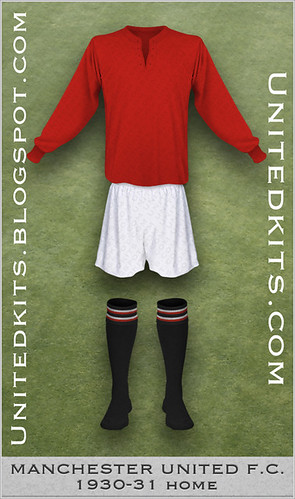
United players (Stan Gallimore centre) pictured in the 1930/31 season in new lace-necked jerseys (minus laces):

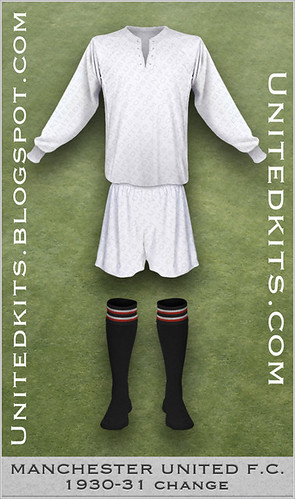
Photos on the computer screens at the United museum show players in white change shirts in the same style as the home ones:
In Justin Blundell's "Back From the Brink", United supporter Hubert Stewart, who was a child living with his family in Old Trafford at the time, reminisces about the time of the boycott:
"My father was on the committee of the Official Supporters' Club...(who) used to do their bit to help the club financially and at one time my mother took to washing the jerseys. All the women used to take it in turns to wash the jerseys to save the club's laundry bill. I can't remember how long it lasted but I can remember my mother complaining that it wasn't her turn to do them."
As United prepared to begin life in the second division in 1931/32 they faced financial meltdown. The economy as a whole was in dire straits and unemployment continued to rise. They club had made a loss of £2,509 the previous season and now hadn't even the cash to pay the players wages during the summer. Old Trafford was becoming a burden and the diminishing attendances were a major reason for the mounting debts. The club tried to increase numbers by reducing prices and offering tickets to the unemployed at a further reduced rate but the plans were vetoed by the FA. They had been keeping themselves above water by securing loans from Davies' widow but they could no longer rely on these to keep them afloat.
After winning just 16 points from their first 19 games, the board's belief that United would simply be able to save themselves from collapse by playing their way out of trouble on the football pitch was no more. Crowds above 10,000 had become a rarity and Crickmer had been told by the National Provincial Bank in Spring Gardens that they had withdrawn the club's credit. For the second time in 30 years, the club were close to bankruptcy.
Just like at the turn of the century, however, there was someone ready to come to the club's rescue. A local businessman and proud Mancunian, James Gibson, had been approached by local football journalist Stacey Lintott (although Louis Rocca would make a similar claim), and told of United's plight. Gibson had no interest in football, but had a reputation as someone who could turn around a failing business and as a person cared about his community. He hated the idea of such a famous institution as United becoming nothing more than a memory and so he agreed to do all he could to prevent this happening. His immediate action was to take on responsibility for the club's expenditure over the Christmas period, with the promise that if he was given enough support he would do so permanently.
The players line up before the away match at Wolves on December 26th 1931. They were thrashed 7-0:

The shirts they are wearing were presumably adopted as part of the home kit at the start of the season and are remarkably similar to the style that was worn by United in the sixties. The change kits are currently unknown, but may have been the same worn during the previous season:
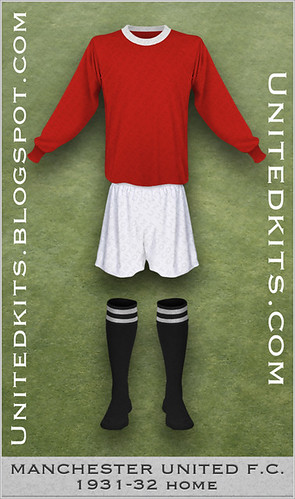
On January 20th 1932, Gibson took full control of the club. By this time he had done much to resolve the conflict between supporters and the management by engaging in talks with Mr Greenhough and revealing that he was already looking to bring in a new manager. He had also made public his dreams of producing a United team made up entirely of Mancunians and his wish to set up a youth team - something which would bring United great success 20 years later.
Attendances at Old Trafford started to rise immediately, several new players were brought in and the team were rejuvenated, winning ten and losing just four more matches during the remainder of the season on the way to a 12th place finish (although United - typically - were knocked out of the cup in the third round).
Attendances at Old Trafford started to rise immediately, several new players were brought in and the team were rejuvenated, winning ten and losing just four more matches during the remainder of the season on the way to a 12th place finish (although United - typically - were knocked out of the cup in the third round).
The 1932/33 team photograph:

This is an edited version of an image from the extensive Leslie Millman collection, which can be found at www.flickr.com/photos/manchesterunitedman1/ and is used with full permission.
Once again, the players are sporting new jerseys:
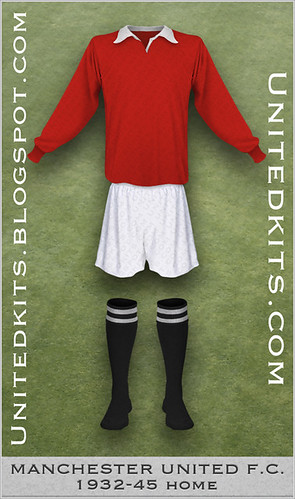
This cartoon from October 1932 dates United's adoption of the cherry and white hooped change kits to the 1932/33 season. The two games referred to are the away matches against Charlton and Burnley:

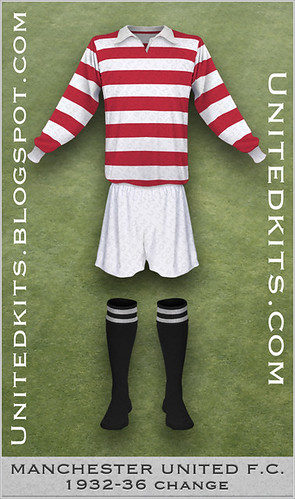
There is an anecdotal story about the hooped jerseys being given to United by Wigan RLFC as a gift to help them out when they were in financial difficulties. They are certainly of a very similar style to those worn by the Rugby League side at the time (as this photograph of Ken Gee shows), but as this cartoon suggests that the kits were first worn after the Gibson takeover (and subsequent injection of his cash), there seems to be little to back up this tale.
United's progress under Gibson continued in 1932/33 as players such as George Vose and Tommy Frame were signed and Scott Duncan was installed as manager. The highlight of the season was probably the 7-1 home win against Millwall, but the Reds' poor away form meant all they could manage was a sixth place finish. Yet again the cup campaign was over 90 minutes after it began.
For the 1933 FA Cup Final, Everton and Manchester City wore numbered shirts for what is believed to be the first time. Everton (who won 3-0) wore numbers 1-11 while City wore 12-22. The FA made shirt numbering compulsory in 1939. The exact date when United first wore numbered shirts is currently unknown, however.
The 1933/34 season was perhaps the most desperate in United's history. After they had seemed to have turned the corner since the Gibson takeover, remarkably by the season's end, the club would find itself on the brink of relegation to the third division.
The season opened with a 4-0 loss at Plymouth and it wasn't until the sixth league match away to Brentford that United registered their first win. By the beginning of December, United looked to have staged a recovery, but after the win at Port Vale on the 2nd of the month, they would only pick up three points over the next thirteen games (as well as being knocked out of the cup by Portsmouth in a third round replay during the same period). Also, for the third time in four seasons, United conceded seven goals during one of their Christmas fixtures (this time away to Grimsby Town!) .
The only league win during those thirteen fixtures was away to Burnley, where United wore the cherry and white hooped jerseys. Keen to seize upon anything that may offer United hope of escaping the drop, the "lucky" reputation of the hooped strips grew among supporters and players alike. So much so, that for the home game against Bury on March 3rd, the players turned out in the hoops at Old Trafford - and won 2-1 with goals from Jack Ball and Stan Gallimore. For the remainder of the season the hoops would remain first choice kit (presumably the solid red jerseys were used for away matches when there was a colour clash - possibly at the Dell against Southampton).
By the end of April, United found themselves teetering on the precipice. Lincoln had already been relegated and either United or Millwall would follow them. As fate would have it, those two sides were to meet in a decider at The Den on the final day of the season.
A tense, nervy affair could have been expected, but as it happened, United - by all accounts - enjoyed a comfortable 2-0 win to guarantee their place in the second division the following season. On their return to Manchester they were given a heroes welcome by around 3,000 fans at Central Station. It was a far smaller crowd than had welcomed home Manchester City's players (including a 24 year-old Matt Busby and a young goalkeeper called Frank Swift) after their FA Cup final victory over Portsmouth a week earlier*, but it marked a point where United were in the trough of the wave of success while City were at it's peak and that situation would eventually be reversed.
*A recent article in Four Four Two magazine states that the 1934 FA Cup Final was the first occasion that both sides were outfitted by Umbro, who would feature heavily in the story of United's kits.
Wednesday, 12 August 2009
1922-1927: The Chapman Years
This period of English football is best remembered for Herbert Chapman leading Huddersfield Town to successive titles before leaving them for Arsenal and immediately turning the north Londoners around from a side battling relegation to one challenging for the title. In his first season in charge of the Gunners, he steered them to second place - just five points behind his previous club, who had become the first side to win the league three times in a row. By the time of his death in 1934, he had repeated his achievements in West Yorkshire with Arsenal and set them well on their way to emulating the Terriers by winning a consecutive hattrick of titles for themselves. Legend also has it that Herbert Chapman had a hand in designing Arsenal's kits - giving their plain red jerseys the now iconic white sleeves.
Chapman's namesake at United did not fare quite so well, although he did eventually succeed in returning the club to the First Division and similarly had a big influence in their kit design.
For home games in the 1922/23 season, United turned out not in their now familiar red jerseys, but in white ones with a red "V" (or more properly "diamonds", as there was another V on the back of the shirts joined at the shoulder seams). These shirts were very similar to those worn by United in the 1909 FA Cup Final victory, albeit with a larger, thicker diamond and a button collar rather than a lace one.
Perhaps the reason for this change was a belief that a design worn back in the glory days would inspire a renaissance at United. More likely however, is that the change was down to the new manager's previous club. He had joined from Airdrieonians, who had been wearing identical kits for a decade (in fact, Airdieonian's nickname was The Diamonds, due to the design of their kit).
When Chapman took over at Airdrie, they had been wearing red and white stripes or hoops, so it seems he may have been instrumental in introducing the new design there, too. Perhaps the jerseys had made the journey south along with John Chapman when he took up the post at United. We will almost certainly never know for sure, but the white shirts would remain United's first choice for the next five years.

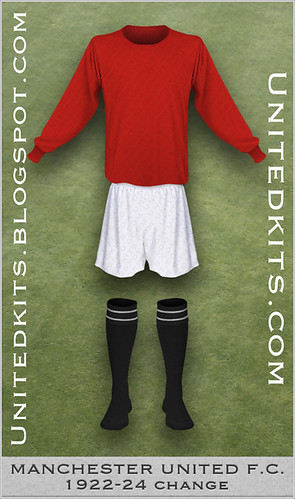
The team photographed before the away match at Wolves in the 1922/23 season:
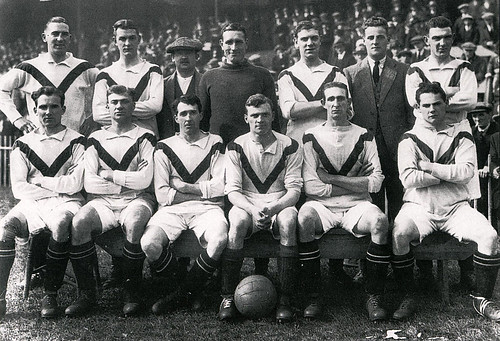
In the top left of the picture is Frank Barson, who was making his United debut. He had been signed for £5,000 from Aston Villa, with whom he had won the FA Cup in 1920, and he came with a notorious reputation having been sent off and suspended on numerous occasions in an era where receiving a red card was a rarity. In his contract was written an agreement to make Barson the landlord of a pub in Manchester if United were to be promoted (presumably due to the club's continued patronage by JH Davies). He would go on captain the club during his six years at Old Trafford before being transferred to Watford in 1928.
United's optimism for the 1922/23 season wasn't quite matched by their performances as they found the second division a little tougher than they had expected. They had enjoyed some decent results, such as a 6-1 win against league leaders and eventual champions Notts County, but they had drawn far too many games and finished three points shy of promotion in fourth place. Their cup run in now typical style had ended in the second round, beaten 4-0 by Spurs at White Hart Lane. Worryingly, it had been a decade since United had progressed any further in the competition.
United's dismal FA Cup record continued in the 1923/24 season when the two Chapmans met at Old Trafford in front of a crowd of 67,000 supporters. Huddersfield, who had finished third in the league the previous season proved too much for United, and won the game easily by three goals to nil.
The Red's league form slumped that season and they finished the season in a lowly 14th place having won only 13 matches - fewer than they had lost (15) or drawn (14). They hadn't finished in as low a position since the Newton Heath days.
The team are photographed before a practice match prior to the 1924/25 season. Half of the players appear to be wearing the old (now faded and stretched) home jerseys worn from 1920-22. Presumably they had been worn as change jerseys since the adoption of the white home shirts:

These photos are part of the extensive Leslie Millman collection that can be found at www.flickr.com/photos/manchesterunitedman1/ and are used with full permission.
The only change to these kits are the slightly different socks worn:
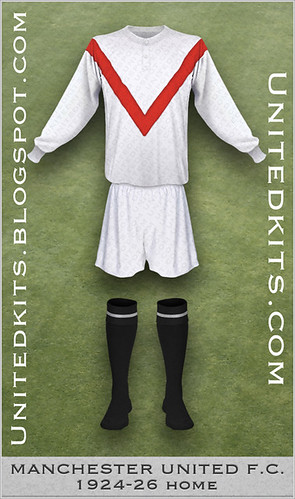

The only change to these kits are the slightly different socks worn:
The 1924/25 season saw United's cup run end at the earliest possible stage with a 2-0 loss at fellow second division side Sheffield Wednesday, but their league form was much improved. They strung together an impressive seven wins on the trot in Autumn to top the table and only lost two games in the rest of 1924. They had been deposed at the top by Leicester City, but promotion was virtually assured after a 4-0 home win against Port Vale in the penultimate match, leaving challengers Derby only a slim mathematical chance of taking United's place in the top flight the following season. United's players stayed on the pitch at the end of their fixture and the supporters waited inside Old Trafford with them, anxiously awaiting news of the other games. A huge cheer went up from fans and players alike when it was announced that Derby had been held to a draw at Coventry - United were back in the top flight after three years. Taking much of the credit were the defence who had conceded only 23 goals all season.
Legend has it that Frank Barson was given the keys to his pub shortly afterward, but his name would not remain over the door for long. Apparently, just minutes after it opened, he became so fed up of all the supporters pouring in off the streets to congratulate him, he handed the keys to a waiter, told him the place was his and left - never to return!
The following season saw United improve dramatically. In the league they finished in an impressive 9th place. They had accumulated the same amount of points as Liverpool and Aston Villa but had an inferior goal average. Had it not been for a run of five losses in April, the Reds may well have finished in the top four or five.
On September 12th the first Manchester derby to take place at Maine Road - where City had moved two years previously - was played. It was a 1-1 draw, which was a decent result considering the return fixture saw United hammered 6-1, the Reds biggest derby defeat to date.
Almost miraculously, United came close to ending their 17 years of cup disappointment by reaching the semi-final against their City rivals, having seen off Port Vale, Spurs, Sunderland and Fulham. Sadly, the blues comfortably beat United 3-0 at Bramhall Lane, but it was not to be their year either as they lost the final 1-0 to Bolton and were relegated a week later after losing to Newcastle 3-2 (having missed a penalty in a match they had only needed a draw from to guarantee survival). Apparently a local newspaper's headline the following day read "Bitter Experiences of Manchester City"...
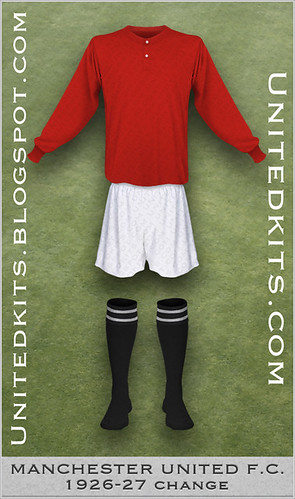
During the FA Cup tie at Spurs, United were photographed wearing red change shirts with button collars like those on the home shirts:

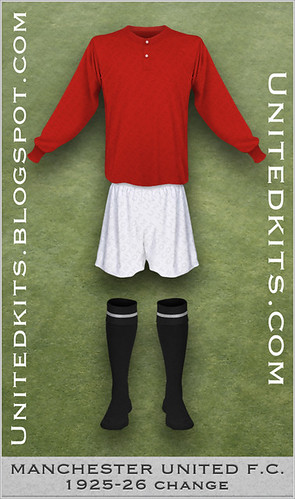
The 1926/27 season was less remarkable for United - at least as far as the events on the pitch. Once again United went out of the cup in the first round, albeit after taking their tie against Reading to a second replay at Villa Park, where they lost 2-1. They won only four fewer points in the league than they had the previous season, but it was enough to see them finish six places lower, in 15th position.
There were also slight changes to the kits as different socks were worn (photographs of this period are fairly difficult to get hold of, but these images have been made with reference to pictures on the computer screens at the United museum):
There were also slight changes to the kits as different socks were worn (photographs of this period are fairly difficult to get hold of, but these images have been made with reference to pictures on the computer screens at the United museum):
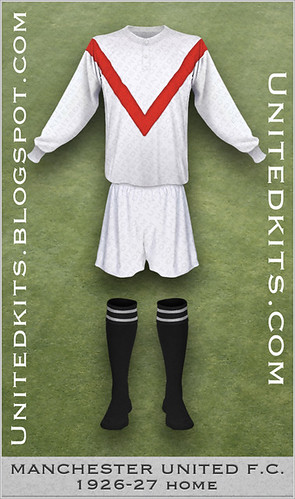
What the season was ultimately to be remembered for was the suspension of John Chapman. The FA had launched an investigation into the manager in September 1926 at Manchester's Grand Hotel. On October 7th, they announced that Chapman had been suspended "from taking part in football or football management during the present season for improper conduct in his position as Secretary-Manager of the Manchester United Football Club"". No further explanation was ever given and Chapman never returned to his position. Appointed in his place temporarily as player-manager, was Lal Hilditch, who had joined the club a decade earlier, during the war. His brief tenure lasted only until the beginning of April when Herbert Bamlett was given the job. Hilditch remains the club's only ever player-manager.
On the other side of Manchester, there was another one of those "typical City" moments, when on the last day of the season, the Maine Road side demolished Bradford 8-0 to almost certainly secure promotion ahead of Portsmouth, who had gone into the final round of fixtures with a minutely superior goal average and who City fans heard had been drawing 1-1 with Preston at half time. Just as celebrations were about to get underway in Moss Side, however, Pompey scored four second half goals to win 5-1 and pipped City to second place by the most minuscule margin: +0.006 goal average.
On the other side of Manchester, there was another one of those "typical City" moments, when on the last day of the season, the Maine Road side demolished Bradford 8-0 to almost certainly secure promotion ahead of Portsmouth, who had gone into the final round of fixtures with a minutely superior goal average and who City fans heard had been drawing 1-1 with Preston at half time. Just as celebrations were about to get underway in Moss Side, however, Pompey scored four second half goals to win 5-1 and pipped City to second place by the most minuscule margin: +0.006 goal average.
Subscribe to:
Posts (Atom)